

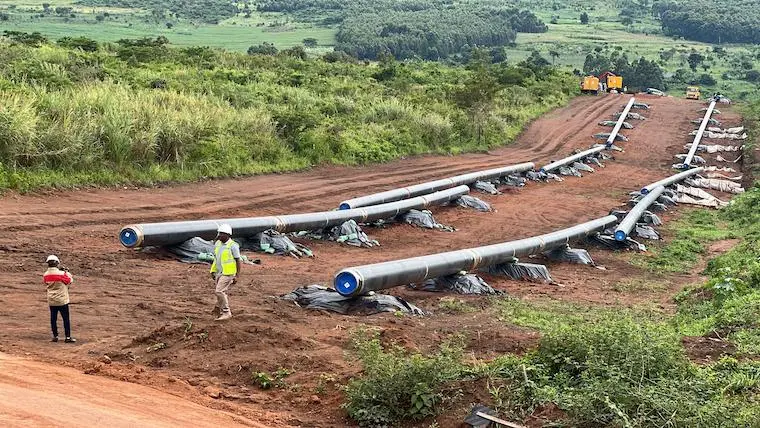
Kampala — The East African Crude Oil Pipeline (EACOP) project in Uganda has achieved a significant milestone, with over 1,000 kilometers of pipeline welded since construction began in 2023. The development marks a major step forward in the region’s largest oil infrastructure project, which aims to transport crude oil from Uganda’s oil fields in Hoima to the Tanzanian port of Tanga for export.
According to TotalEnergies and the Uganda National Oil Company (UNOC), the milestone reflects the project’s steady progress despite logistical, environmental, and technical challenges. EACOP, spanning approximately 1,445 kilometers, is designed to be the world’s longest electrically heated crude oil pipeline, with a capacity to transport 216,000 barrels per day.
Project officials highlighted that welding is one of the most critical stages of pipeline construction, requiring precision, safety adherence, and rigorous quality control. “Reaching over 1,000 kilometers of welded pipeline is a testament to the dedication and expertise of our workforce, as well as our commitment to meeting project timelines while prioritizing environmental and social safeguards,” said the EACOP project director.
The pipeline, which passes through sensitive ecological zones and multiple communities in Uganda and Tanzania, has been accompanied by extensive environmental and social programs. These initiatives include resettlement of affected communities, compensation schemes, biodiversity conservation efforts, and continuous stakeholder engagement to minimize negative impacts.
Economists and industry analysts say the completion of the pipeline is expected to boost Uganda’s economy by enabling large-scale oil exports, generating revenue, and creating employment opportunities. The project has already provided thousands of jobs during construction and is anticipated to enhance regional trade and infrastructure development.
Environmental groups, however, continue to raise concerns regarding potential risks to water resources, ecosystems, and local livelihoods. Project developers have repeatedly stated that mitigation measures are in place, including advanced monitoring systems and emergency response plans.
With over 1,000 kilometers already welded, EACOP is advancing toward operational readiness, and authorities anticipate that the project will play a pivotal role in transforming Uganda into a key oil-exporting nation in East Africa.
